On June 21-22, thousands of representatives from Western governments and businesses gathered in London for the Ukraine Recovery Conference (URC23). Officially, the meeting’s purpose was to “support Ukraine’s recovery”. But a closer look reveals that Western corporate elites convened in the British capital for somewhat less altruistic reasons: namely, to stake their claims to the massive profit opportunities being created by the war. This becomes apparent when one considers that last year the Ukrainian government essentially outsourced the entire post-war “reconstruction” process to BlackRock, the world’s largest asset management firm. In February, J.P. Morgan was brought on board as well. The two banks will run the Ukraine Development Fund, which aims to raise private investment in projects potentially worth hundreds of billions of dollars across sectors including tech, natural resources, agriculture and health. The opportunities are significant, particularly in the agricultural sector: Ukraine is home to a quarter of the world’s chernozem (“black earth”), an extraordinarily fertile soil, and before the war it was world’s top producer of sunflower meal, oil and seed, and one of the biggest exporters of corn and wheat. From certain perspectives, the war is clearly good for business: indeed, the greater the destruction, the greater the opportunities for reconstruction. At Davos this year, Larry Fink, CEO of BlackRock, said he hoped the initiative would turn the country into a “beacon of capitalism”. Read the rest of the article here.
Hi everyone, I’ve got two new pieces fresh from the oven. In my first article, “How America control Europe”, published in Compact, I reflect on Western Europe’s transformation into an American protectorate administered from Brussels — and how this explains the masochistic policies pursued by the EU vis-à-vis Russia-Ukraine, and its glaring silence over America’s (glaringly obvious) role in the terrorist attack on the Nord Stream pipeline. 

Meanwhile, for UnHerd, I’ve written about the Bank of England’s latest interest rate rise and why it has little to do with “fighting inflation” — and much to do with crushing workers by crashing the economy. 

I’ve written for UnHerd about how Labour is already selling out before it’s even in office, by pre-committing a future Labour government to permanent austerity. This is the legacy of the Labour’s takeover by the Blairite neoliberals: a party paralysed by fear — of the markets, of the orthodoxy, of Washington, of the voters.

Back in 2021, Keir Starmer put forward ambitious spending plan, which involved borrowing £28 billion a year until 2030 to spend on green transition policies, such as subsidising wind farms, insulating homes, building battery factories and accelerating Britain’s nuclear programme. One may disagree on the specifics of Labour’s plan, but at least it reflected an acknowledgment that achieving greater economic resilience — “green” or not — requires big spending commitments.

However, as several commentators pointed out at the time, Labour’s spending plan would be almost impossible to reconcile with its obsession with fiscal discipline and “sound money”. Under the Corbyn leadership, the party adopted a set of stringent “fiscal rules” aimed at cutting government debt, which it promised to abide by once in government, which were then further strengthened by the new leadership — and no one is more rigidly committed to those rules than shadow chancellor Rachel Reeves. It’s therefore hardly surprising that Reeves recently announced she was abandoning the party’s policy of big borrowing because “no plan can be built that’s not on a rock of economic and fiscal responsibility”. Keep reading here.

In my latest piece for UnHerd, I reflect on Berlusconi’s legacy and on his influence on my own political identity, from my early dabbling in left-wing politics in the early Nineties and the tragic violence of the anti-G8 protests in 2001 to my disillusionment with the obsessive and myopic anti-Berlusconismo of the Italian left. Ultimately, for all his many faults, Berlusconi tried to assert a degree of national autonomy — and that’s why the Euro-Atlantic establishment brought him down in 2011. Since then Italy’s politicians have morphed into mere implementers of foreign diktats. Meanwhile, the Italian left, by obsessively focusing on Berlusconi and his threat to democracy, ended up ignoring — or worse, embracing — the more significant structural trends that have been weakening Italian democracy and sovereignty for the past 20 years and more: the gradual erosion of sovereignty at the hands of the EU and later the euro; the growing power of the technocratic apparatuses of the state, such as the Bank of Italy and the President of the Republic; the undermining of Italy’s strategic interests by its supposed allies, exemplified by the Nato-led attack on Libya in 2011. Read the article here.

The Biden administration, after successfully convincing Europe, against the latter’s own interests, to join America’s proxy war against Russia, is now hard at work to bring the EU on board with Washington’s increasingly aggressive anti-China policy — which involves not only economic decoupling (or “de-risking”, as it’s now called), by restricting trade and investment flows and technological transfers between China and the West, but also increasing NATO’s presence in the Indo-Pacific. The consequences for Europe could be even more significant than the economic shock of the past year. Yet, despite a few grumbles from Macron and others, European leaders are largely playing along. However, Western corporations — on both sides of the Atlantic — are refusing to along with the the US-Western strategy of decoupling from China, and the militarisation of great-power relations more in general. Prominent CEOs are travelling to China and vowing to continue investing in the country. Such open defiance of Washington’s militaristic foreign policy by Western big business represents a striking development. Critics of US-Western foreign policy and military interventionism have traditionally (and correctly, in my view) seen the latter as being essentially aimed at enforcing the Western-led global capitalist order — in other words, as being in the service of big business. However, in light of the growing rifts between America’s economic and political elites, does this analytical framework still hold? Or have the interests of the military-industrial complex decoupled from those of the “general interests” of the capitalist class? Read my latest article here.

For weeks we’ve been hearing that either Congress raises the debt ceiling or the US faces a catastrophic default — potentially as soon as this week, Yellen said. Now an 11th-hour deal between Biden and the Republicans (which still needs to be rubber-stamped by Congress) has averted default in the nick of time — or so we are told. In fact, as I write in UnHerd, the whole debt ceiling drama is little more than stagecraft. The notion that the US government can “run out of money” and/or default is simply ridiculous. As the issuer of the currency, the US government can neither run out of money nor become insolvent on its debt. In other words, these recurrent “fiscal crises” are entirely of the US’s own making, stemming as they are from a rule — the debt ceiling — that it has imposed upon itself. Indeed, the US is only one of two countries in the world with a rule of this kind. So does the existence of the debt ceiling mean that the risk of default was real? No. As I explain in the article, there were/are several legal and technical alternatives to a default, even in the absence of a debt ceiling raise — indeed, the idea that the US government would have allowed itself to auto-default due to an archaic century-old law was never a serious proposition. So why all the scaremongering? Ultimately, it’s hard not to conclude that the whole purpose of the debt ceiling is precisely to allow for the engineering of artificial fiscal crises that allow the two parties to engage in a bit of cosplaying only to ultimately reach a budgetary “compromise” which always which boils down to austerity for the working classes and trillions for the corporate elites. Read the article here.

On May 27, Henry Kissinger will celebrate his one-hundredth birthday. His centenary couldn’t come at a more symbolic time: Kissinger’s century was the American century, and they’re both coming to a close. Kissinger is probably America’s most controversial and polarising statesman — reviled as a war criminal by his critics, hailed as a master in the art of diplomacy and a peacemaker by his admirers. On one point everyone agrees: few people have had a bigger impact on US post-war foreign policy than Kissinger. As National Security Advisor and Secretary of State from 1969 to 1977 under Presidents Richard Nixon and Gerald Ford, Kissinger played a pivotal role in marshalling the United States through one of the Cold War’s most violent and turbulent decades. What one chooses to emphasise about Kissinger’s political record depends on where one sits in the “Kissinger wars” — the fierce intellectual battle that has been raging on for decades over the statesman’s legacy. According to his detractors, Kissinger was above all an imperialist who pursued US global supremacy with unmatched ruthlessness and cynicism. At the other end of the ideological spectrum we find the Kissinger-as-diplomatic-genius-and-peacemaker camp. Who’s right? Read my latest article here.

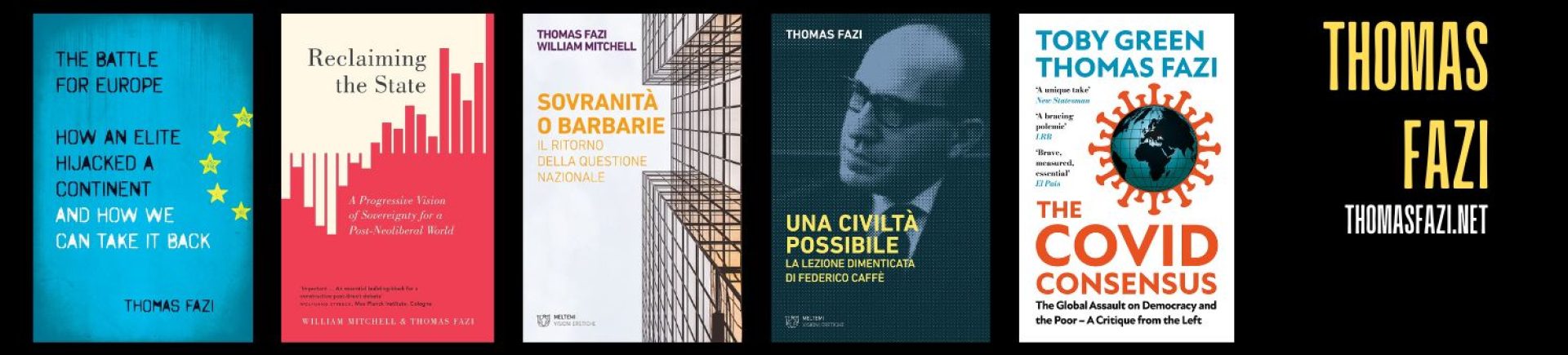
Now that the US and WHO have both declared an end to the Covid health emergency, one might be tempted to think that the pandemic nightmare is truly, finally over. Indeed, for most people, it had already been overtaken by more pressing issues, ranging from inflation to war. But for those of us who maintained that the real nightmare was not the virus itself (which never a serious threat for the vast majority of the world’s population), but rather the governments’ dystopian response to it in the name of “public health” — the deployment of disastrous biomedical protocols, the upending of human life as we know it, the violation of citizens’ most fundamental civil rights, the state’s intrusion into the most private aspects of our lives (including birth, sex, worship, death), and even our bodies, the sweeping aside of democratic procedures and constitutional constraints, the militarisation of societies, the introduction of extraordinary measures of social control, the discrimination and stigmatisation of non-compliant citizens, the rampant use of propaganda and censorship, the massive transfer of wealth — there is little to celebrate. Not only do most people still subscribe to the Covid consensus, but vast resources are now being poured into consolidating the “accepted story” of the past three years — what we might call the post-Covid consensus. Read the article by Toby Green and I here.

I’ve got a new piece up about how austerity is returning to Europe, but with a perverse twist: while the EU is devising a plan to get states to cut their overall budgets, it is also calling on governments to increase their defence budgets to at least 2% of their GDP to comply with NATO’s spending target. In other words, European countries will soon be required to cut back on social welfare and crucial investment in non-defence-related areas in order to finance the EU’s new defence economy — we might call this military austerity — in the context of the bloc’s increasingly vassal-like subordination to US foreign policy. Welcome to the age of military austerity.

I’ve written for UnHerd about the new scramble for Africa — the struggle between Western countries, China and Russia for influence over this immensely resource-rich, young continent predicted to be the next frontier of growth. In this game, Russia is particularly well-positioned. More so than the West, it enjoys strong historical and ideological ties with many African nations, given that the Soviet Union was the primary ally of several nations on the continent during the Cold War. Meanwhile, Sino-African relations are also deepening, with China now the continent’s largest trading partner and main source of project finance in the context of the Belt and Road Initiative. This has included massive infrastructural projects: railways, roads, dams, ports and airports. China’s approach differs starkly from the Western one, which continues to be heavily reliant on military force and repression — what some might call neocolonialism. Just last year, the US bombed Somalia and Niger. Meanwhile, American special operations teams are playing a direct role in military actions in at least eight African countries, including Somalia, Kenya, Tunisia and Niger, under a set of classified “surrogate programmes”. Read the article here.