Now and then, even the most seasoned politician happens to slip up and accidently speak the truth. This is what occurred during a recent debate at the Parliamentary Assembly of the Council of Europe, when the German Foreign Minister Annalena Baerbock openly stated that “we are fighting a war against Russia”. The German government was quick to say her words had been “misinterpreted”, but the truth is that she did nothing more than say it how it is. Almost a year into the conflict, the narrative of Western intervention in Ukraine — that “NATO is not at war with Russia” and that “the equipment we’re providing is purely defensive” — is being revealed for what it always was: a fiction. Read the article over at UnHerd.

Toby Green and I have written an article about the highly disturbing (but underreported) phenomenon of excess deaths: in all Western countries, people are dying at much higher rates than the pre-pandemic average, and only a fraction of these deaths are attributable to Covid. More young people are dying today than during the pandemic. This is the opposite of what you would expect in the receding phase of a pandemic — one which has largely spared young people in the first place. What the hell is going on? The collapse in routine healthcare appointments (due to the single-minded focus on Covid at the expense of all other pathologies), and the impact of lockdowns on people’s physical health, clearly play a role. But could there be other factors at play took? What role, if any, do the Covid vaccines play? Read on.

Hi all, I’ve written an article explaining why it’s high time we overcame our irrational fear of nuclear energy — a perfectly safe, zero-emission clean energy source — and embraced its revolutionary potential to offer cheap abundant energy for decades to come. The article is filled with lots of of myth-busting trivia about this tragically misunderstood technology.

Hi all,

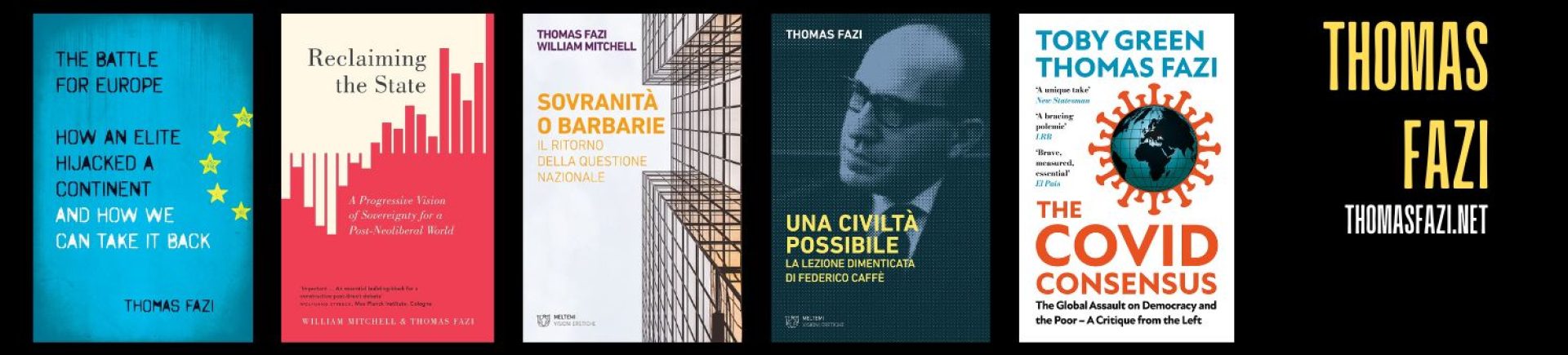
I’m proud to announce that the book I co-authored with Toby Green of King’s College London — The Covid Consensus: The Global Assault on Democracy and the Poor—A Critique from the Left — is finally out!

Here’s the description:

During the first years of the pandemic, the political mainstream agreed that “following the science” with hard lockdowns and vaccine mandates was the best way to preserve life. But social science reveals the true human cost of this policy.

The Covid Consensus provides an internationalist-left perspective on the world’s Covid-19 response, which has had devastating consequences for democratic rights and the poor worldwide. As the fortunes of the richest soared, nationwide shutdowns devastated small businesses, the working classes and the Global South’s informal economies. Gender-based violence surged, and the mental health of young people was severely compromised. Meanwhile, unprecedented health restrictions prevented participation in daily life without proof of vaccination.

Toby Green and Thomas Fazi argue that these policies grossly exacerbated existing trends of inequality, mediatisation and surveillance, with grave implications for the future. Rich in human detail, The Covid Consensus tackles head-on the refusal of the global political class and mainstream media to report the true extent of the erosion of democratic processes and the socioeconomic assault on the poor. As the world emerges from the pandemic to confront new modes of monitoring and control, this left-wing reappraisal of global Covid policies exposes the injustices and political failings that have produced the biggest crisis since the Second World War.

You can buy the book the book here: https://www.hurstpublishers.com/book/the-covid-consensus/.

I’ve also got a new piece out at Compact Magazine: The Deglobalization We Need. It’s a review of Rana Foroohar’s latest book, Homecoming: The Path to Prosperity in a Post-Global World. In it, I argue that Foroohar’s analysis of the opportunities offered by the end of hyperglobalisation is compelling, but that the author tends to gloss over the imperialistic drive behind the US’s embrace of deglobalisation.

Following the easing of Covid-19 polices in China, which was quickly followed by a spike in cases, several countries — including the US, Japan, Italy, Spain, France and, most recently, the UK — have reacted by reintroducing restrictions for passengers from China, requiring them to show a negative PCR or antigen test before boarding. The fact that Western countries are still resorting to such tried-and-failed policies as pre-departure testing — which had no effect on the global spread of previous variants from several countries — is a staggering indictment of just how little they’ve learnt from past failures. Indeed, the uselessness of such policies is now so clear that it’s hard to shake the impression that the decision is a purely political one. Part of the explanation is that politicians, by peddling a pro-lockdown narrative for the past three years, have now created an artificial demand for restrictive measures among their fear-stricken constituents, some of whom are now even making the case for wearing masks forever or for the permanent institutionalisation of what Giorgio Agamben might call “bare life”. Even more worryingly, it appears to indicate that Western governments have little intention of giving up the powers they’ve claimed under the guise of “fighting the virus”. You can read the rest of the article, which I’ve co-authored with Toby Green, in UnHerd.

I hope you’re enjoying your holidays. Even though I had promised to myself that I would take a break, I couldn’t avoid writing about the latest #TwitterFiles drop, where journalist David Zweig shares what he found when looking at what the Twitter archives had to say about the “content-moderation policies” employed by the company throughout the pandemic. His findings confirm what various leaks, FOIA requests and ongoing lawsuits had already begun to disclose. “The United States government pressured Twitter to elevate certain content and suppress other content about Covid-19 and the pandemic”, says Zweig, who claims he viewed internal email showing “that both the Trump and Biden administrations directly pressed Twitter executives to moderate the platform’s content according to their wishes”. The result was that “dissident-yet-legitimate content was labeled as misinformation, and the accounts of doctors and others were suspended both for tweeting opinions and demonstrably true information”. The ultimate tragedy about all this is that we were prevented a debate on possible alternatives to school closures, lockdowns, vaccine mandates, and the like — alternatives that might have spared us a lot of the destructive consequences of these policies: collapsing living standards, deadly backlogs in the health system, declines in children’s learning abilities and people’s mental health, democratic backsliding, etc. You can read the article on Compact.

After months of wrangling, EU energy ministers finally approved the first ever cap on gas prices, which is scheduled to come into force in February. The aim of the measure is to curb the crisis that has been rocking Europe over the past year as a result of gas and energy prices surging to unprecedented levels. Since there’s a lot of confusion about what the cap really is, I’ve written a brief explainer. In short, this isn’t a cap on price-gouging by Russia (or anyone else); it’s a cap on the system of speculative trading (the TTF in Amsterdam) that the EU has deliberately foisted upon its energy markets. In other words, it’s yet another case of the organisation attempting to fix a problem of its own creation.

I’ve published a few pieces since my last update. The latest one is about the “Qatargate” scandal that has engulfed the European Parliament. In it, I explain that the scandal, far from being an isolated case, is an epiphenomenon of a much deeper and more widespread malaise, involving not just the European Parliament but all EU institutions. Bribery and corruption are endemic to the Brussels system — and most of it is perfectly legal. The EU, by virtue of its supranational and technocratic nature, is structurally prone to capture by vested interests, be they foreign governments or multinational corporations — and no amount of reform will change that.

Last week I wrote about the divergent interests of Europe and the US in the Ukraine conflict. Europeans seem to be (very slowly) waking up to the fact that America’s interests are no longer aligned with Europe’s (if they ever were). In the US’s new post-globalisation strategy, Europe isn’t seen as a strategic ally but as a competitor and a rival, which the US has every interest in keeping in a subordinate position. Indeed, it seems far from unreasonable to posit that one of the aims of the US strategy in Ukraine may be precisely to downgrade European manufacturing, drive a wedge between Europe and Russia, strengthen US hegemony over the continent, and end Europe’s aspirations to “strategic autonomy”.

I also wrote a couple of shorter piece: one about the serious threat to online free speech posed by the EU’s new Digital Services Act (DSA) that came into force last month, and another one about Merkel’s recent interview in Der Spiegel, where she seems to imply that the Minsk agreements were designed to fail: Ukraine and Western countries (Germany, at least), Merkel seems to say, never had any intention of negotiating a peace deal in which the Donbas republics would enjoy a degree of autonomy; the agreements were little more than a delaying tactic in order to buy time for Ukraine to arm itself.
I’ve written about the increasingly popular theory of degrowth communism. Its message is simple: capitalism’s drive for profit is destroying the planet and only “degrowth communism” can repair the damage by slowing down social production and sharing wealth. Humans need to find a “new way of living”, and that means replacing capitalism. However, there are serious unintended consequences to this theory, which actually risk empowering the globalist capitalist elites degrowthers proponents claim to be fighting. This is what I consider to be the most concerning element of degrowthism (and any other form of apocalyptic environmentalism): by constantly engaging in “doomerism” — the idea that either we fix everything or we’re all screwed — they’re effectively saying that anything is justified in order to “save the planet”, including all manner of authoritarian interventions. It’s like Zero Covid on steroids. After all, if the very survival of life on Earth is at stake, surely we can’t allow the complexities of democratic debate and deliberation to stand in the way of doing what’s needed? In this sense, doomerism offers a political cover to what is ultimately the easiest way to reduce people’s consumption levels: making ordinary people poorer — which indeed seems to be the solution pursued by elites. You can read the full article here.